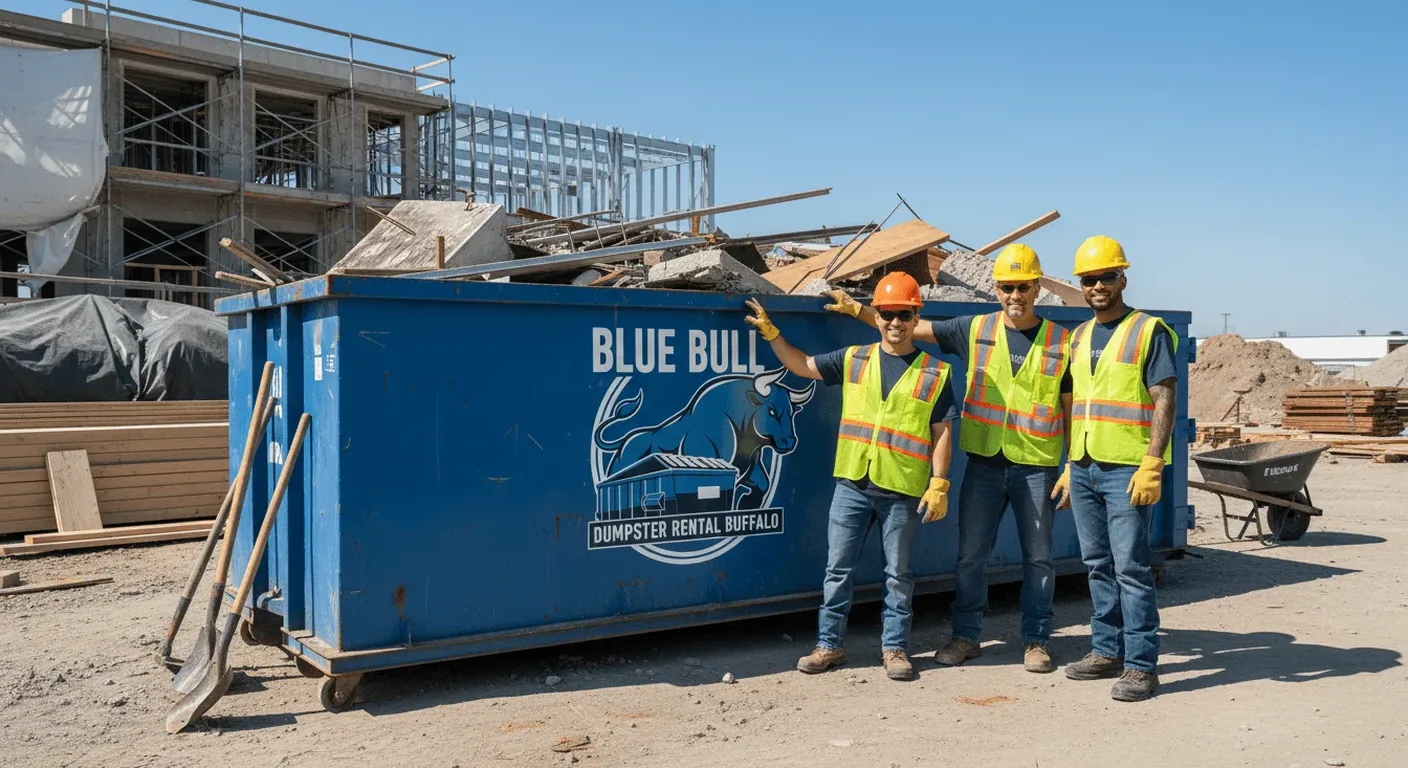
Demolition Debris Removal · Buffalo, NY
Demolition Debris Removal in Buffalo, NY
From a detached garage teardown in South Buffalo to a full interior gut in Amherst, Blue Bull sizes a roll-off to your demolition debris and hauls it away on your schedule.
- Same-day & next-day delivery
- Flat-rate, all-in pricing
- Driveway protection included
- Same-Day DeliveryCall before noon and we can usually be there today.
- Flat-Rate PricingDelivery, pickup, disposal and tax quoted up front.
- Licensed & InsuredFully insured and licensed to haul in New York.
- Locally OwnedLocally owned and operated, based right here in Buffalo.
Overview
Demolition Debris Removal in Buffalo
Pulling down a backyard shed in Cheektowaga, tearing off a rotted porch in Lackawanna, or gutting a kitchen down to the studs in a century-old West Side bungalow all leave behind the same problem: a pile of mixed demolition debris that has to go somewhere. Old lumber, plaster and lath, drywall, cabinets, flooring, trim, and the odd nail-studded board pile up fast once the demo work starts.
Blue Bull delivers a roll-off sized to the job, drops it in your driveway or at the curb, and picks it up when you're done — one flat rate covers delivery, pickup, and disposal, with no hidden add-ons. Whether you're a homeowner tackling a weekend garage teardown or a contractor clearing a full interior demo in Elmwood Village or out in the Erie County suburbs, we size the container to the debris so your job site stays clear.
Demolition debris is usually a mixed load of wood, drywall, and construction material — different from a single heavy material like concrete or brick, which fills a container by weight long before it fills by volume. If your project is mostly slab, block, or foundation masonry, our concrete & heavy debris dumpsters are built for that instead.
Accepted materials
What goes in — and what doesn't
Good for
- Detached garage and shed teardowns
- Deck and porch removal
- Interior gut jobs and plaster-and-lath demo
- Kitchen and bathroom demolition
- Pre-renovation strip-outs in older homes
- Mixed wood, drywall, and cabinetry debris
- Fence and outbuilding removal
Cannot go in
- Concrete slabs, brick, or block (use concrete & heavy debris)
- Large volumes of dirt or excavated fill
- Roofing-only tear-offs (use roofing dumpster rental)
- Paint, solvents, and hazardous chemicals
- Tires, batteries, and propane tanks
- Suspected asbestos or lead-based materials
New York bans a specific list of materials from landfills. If you are unsure about an item, call (716) 274-8073 before it goes in the container — it costs nothing to ask and a lot to sort out afterwards. Full detail in our banned materials guide.
What Counts as Demolition Debris
Demolition debris covers anything generated when a structure or part of one comes down or gets gutted: shed and detached garage teardowns, deck and porch removals, interior demo ahead of a renovation, and the plaster, lath, old cabinetry, flooring, and framing lumber pulled out of a home being stripped to the studs. Most demolition jobs produce a mixed load — old studs alongside sheetrock alongside a few shingles and a busted window sash, not one uniform material.
That mix is exactly what a Blue Bull roll-off is built to handle. Toss in old studs, plaster and lath, drywall, subflooring, cabinet boxes, interior doors, insulation, and general construction debris as the teardown progresses. If your project also involves pulling up a driveway, patio, or foundation footing, that heavier masonry material is better suited to a dedicated heavy-debris load — mixing several cubic yards of concrete into a demolition container can push it over its weight limit fast, even with plenty of open space left in the box.
Sizing for Buffalo's Older Housing Stock
A single detached garage or small deck teardown usually fits in a 10 or 15 yard dumpster — enough room for lumber, roofing, and hardware without paying for space you won't use. Where Buffalo differs from a lot of markets is what's actually behind the walls: the city's dense early-1900s bungalows and two-family doubles were built with real plaster over wood lath instead of drywall, and that material is significantly heavier per square foot than the drywall demo you'd pull out of a newer Amherst or Clarence subdivision home.
Because of that, we often recommend sizing up a notch for interior demo in the city's older housing stock compared to an equivalent job in a newer suburban home — a full-room gut in a century-old double may call for a 20 yard where the same scope in a 1990s Clarence colonial fits comfortably in a 15. Call (716) 274-8073 and tell us the age and size of the home along with what's coming down, and we'll size it based on the material, not just the square footage.
Permits, Dig Safely New York, and Placement
Most demolition dumpsters sit on a driveway or job site with no permit required. If there's no room on-site — common on the narrow lots and short or nonexistent driveways typical of older Buffalo neighborhoods like Black Rock or the West Side — and the container needs to sit in the public right-of-way or on the street, check with the City of Buffalo for street-adjacent projects, or your local town hall and Erie County DPW for suburban right-of-way questions, before delivery.
If your teardown involves any digging, footing removal, or utility work — pulling out an old garage slab, removing fence posts, or prepping for a new foundation — call Dig Safely New York at 811 before you break ground so buried lines get marked. This applies everywhere from a city lot in South Buffalo to a rural property out past Clarence, and it's free.
What Can and Can't Go In
Along with standard demolition materials, Blue Bull dumpsters accept wood, plaster and lath, drywall, tile, flooring, furniture, cabinetry, and old roofing shingles if a tear-off is part of the same project. What we can't take: paint, solvents, oils, tires, batteries, hazardous chemicals, propane tanks or gas cylinders, and medical waste — these need separate disposal regardless of the job generating them.
Older Buffalo homes sometimes turn up things worth flagging before they end up in the container — old paint cans in a garage, a buried oil tank near a foundation, or asbestos-containing material in pre-1980s flooring or pipe insulation. If your demolition uncovers any of that, set it aside and call (716) 274-8073 — we'll tell you where it needs to go, and NYSDEC (dec.ny.gov) has guidance on handling regulated materials from older homes. Sorting these items out before we arrive keeps the pickup on schedule instead of leaving a partial load behind.
Sizing
Which size for this job?
| Container | When it suits this job |
|---|---|
| 10 Yard | Small shed, single-room interior demo, or a short deck teardown |
| 15 Yard | Detached garage, standard deck removal, or a small bathroom gut |
| 20 Yard | Whole-house interior demo in an older plaster-and-lath home |
| 30 Yard | Full interior demo plus an attached structure like a garage |
| 40 Yard | Large-scale demolition across multiple structures or a full home teardown |
Still weighing it up? Read the full sizing guide, compare every container size, or just describe the job on the phone and we will pick for you.
Need demolition debris removal in Buffalo?
One call gets you a size, a flat rate and a delivery slot. Usually under four minutes.
Answers
Demolition Debris Removal — questions we get asked
Can I put garage and interior demo debris in the same dumpster?
Yes. Wood framing, decking boards, shingles, drywall, plaster and lath, cabinetry, and flooring can all go in the same demolition dumpster since they're all mixed construction and demolition waste. Just keep concrete footings or block piers out of the load — those are heavier per yard and belong in a dedicated concrete and heavy debris dumpster instead. Call (716) 274-8073 and describe your project and we'll size one container for everything else.
Why does an older Buffalo home need a bigger dumpster than a newer one?
A lot of Buffalo's city housing stock was built with plaster over wood lath instead of drywall, and plaster is considerably heavier and bulkier to remove than modern drywall. The same room-by-room scope in a century-old bungalow or double often generates more debris, both by weight and volume, than the equivalent job in a newer Erie County suburban home. Tell us the home's age when you call and we'll size accordingly.
Do I need to call before digging for a demolition project?
Yes, if your project involves any excavation — removing a garage slab, pulling fence posts, or prepping ground for new construction. Call Dig Safely New York at 811 before you break ground so utility lines get marked. It's a free service and applies statewide, whether you're in the City of Buffalo or out in an Erie County suburb.
Do I need a permit for a demolition dumpster in the City of Buffalo?
No permit is required for a dumpster placed on your own driveway or private lot. If there's no room and the container has to sit on the street, check with the City of Buffalo for a right-of-way permit, or your local town hall if the job is in an Erie County suburb. We can tell you at booking whether your setup is likely to need one.
What if my demolition uncovers old paint, an oil tank, or suspected asbestos?
Stop and set it aside rather than loading it into the dumpster. Paint, solvents, oils, and materials from a buried tank fall under prohibited hazardous items, and suspected asbestos or lead paint from a pre-1980s home needs specialized handling. Call (716) 274-8073 and we'll point you toward the right next step so the rest of your demolition debris can still go out on schedule.
Service area
We deliver across Erie County and beyond
Verified sources
Local & Official Resources
We are a private hauler, not a government agency. For rules, fees and hours, always go straight to the source:
- City of Buffalo — permits, right-of-way and city services
- Erie County — county services and household hazardous waste
- New York State Department of Environmental Conservation (NYSDEC) — New York solid waste and recycling regulation
- Dig Safely New York (call 811 before you dig) — call 811 before any digging or footing work
- New York State Department of Transportation (NYSDOT) — NYSDOT road and right-of-way information